The Wild Wild West of Asuncion’s Property Boom
In 2026 the Apartment Real Estate market in Asuncion can be summed up in 4 words… The Wild Wild West. It’s not that there are no standards because Paraguay does have standard building codes that every developer has to adhere to. However, asking “Is it up to code?” is not enough. Code compliance is a floor, not a quality guarantee.
 In so called Western real estate markets, investors may have easier access to standardized building ratings and building inspectors, more transparent developer track records, deeper public data, and a clearer culture of technical due diligence.
In Asunción, apart from building-code compliance and whatever records or plans a developer is willing to show you, the onus is on the buyer. That means choosing the right investment is more about choosing the right construction company, disciplined market timing, careful building assessment with the scant data available, and what phase of the property boom and bust cycle you’re buying in.
That being said the demand for apartments is primarily being driven by internal demographics and not immigration. Those demographics would see a property boom that could last well into the next decade. Developers we spoke to said the boom is barely getting started and it has no where near peaked because of the housing shortage that will take construction companies years to catch up with demand.
Current rental yields vary widely depending on whether you purchased off-plan or in an existing building. The occupancy rate of rental properties and Aibnb flats appear uneven. Pricing is often aspirational and effected by lock-box wealth investors which we will elaborate on in this blog. There is no simple centralized system that tells an investor which developer, builder, or building is genuinely strong and which one only looks good in the brochure. So how do you navigate The Wild Wild West as you build your property portfolio in Asuncion?
Let’s break it down and then end on a positive note about the real opportunity for high returns and generational wealth creation.
Before You Buy, Reset Your Thinking
Asunción is still a young apartment-tower unregulated market, in the early stages of evolving into a more established high-rise city. This means when it comes to the building of towers over 7 floors in particular, you need to be mindful that local developers, construction companies, contractors and local workers, don’t have the same experience as Ineternational developers, construction companies, engineers, contract workers and labourers who operate in regulated markets.
As with any city beginning its development into a high rise city, Government is slow to regulate and there’s little to no inspection from a regulator is happening – yet. As it stands right now there are building codes, plans get submitted and approved by the Dirección de Obras Particulares. There’s no follow-up or inspection independent of the company hired to oversea the construction.
You’re not going to have the same level of regulatory oversight, professional standards, service infrastructure, transparency, or independent building-quality verification that you may be used to in more mature regulated property markets.
It’s The Wild Wild West phase, which means self reliance, market research, and local relationship building are going to be the key. Finding the better quality investments both in terms of yield and whether or not you can realise capital gain in a building that holds up over time, will require you to do some leg work. Or work with a local agent that does that for you rather than just lists properties for sale.
There Is No Easy Building Scorecard
 This is where foreign investors often feel the most exposed. In Asunción, there does not appear to be a centralized public system that broadly ranks apartment buildings for quality in the way some investors would hope. There are building codes. There are approved plans. There are municipal processes.
- There is no inspection by a regulator once a building is completed.
- There are no companies or individuals specialising in building inspections that we could find.
Go ahead and Google “Building Inspectors Asuncion” and you find our Property Managerment company at number 3. At number 4 on Google’s list is an instagram post on real estate agents showing potential clients a construction site. Then all the way down the list at the bottom is an Inspection company for trade coming in by the river.
When you Google “Inspectores de Edificios Asunción” the picture is not much better. At number 1 on the list is a company for electrical inspection. Nothing else on page 1 on Google to suggest there is a robust industry of independent inspectors of buildings and construction. The Dirección de Obras Particulares is the sole inspector of the plans only.
In many projects, the construction company both performs the construction and oversees the inspection of its own on-site work, so the same party delivering the build is also responsible for monitoring whether it is being carried out in accordance with the approved plans and permits.
Remember, it’s the Wild Wild West. Regulations and standard classifications have not come in yet.
On much more positive note, there are some big developers and construction companies coming in from Argentina, Chile, andPortugal that we found as an example, with stellar reputations and experience with large projects from apartment towers to stadiums. There are standout companies operating here. You just need to be mindful they are working in an unregulated market in Paraguay and it’s easy to cut corners if a project starts running behind schedule.
In the absence of independent inspection or strong government oversight, the investor must do more of the due diligence themselves. That includes closely assessing the construction company’s track record, its experience with tower construction, particularly in more regulated markets, and the extent to which its reputation, brand protection, ethics, and pride in workmanship suggest a genuine commitment to quality.
There is also an informal classification concept that some developers and realtors may use but again it’s not standardized. It has nothing to do with the engineering or construction of the building and more to do with finishings and amenities. For example a few developers may talk in terms of buildings being Classe A, B, B+ and C. Or Tier 1, Tier 2, Tier 3. But if you ask someone else in the industry what Classe or Tier the building is, you might be met with blank steers. Again, no central system of classification and no standard within the industry. Centralisation doesn’t come in the growth or the boom phase of a developing city. It comes much later.
Because there is no simple, trusted, citywide scorecard telling you which buildings are engineered well, which developers consistently deliver, which towers age badly, or which projects cut corners, investing needs to be navigated more consciously. You will need to do that research on the ground yourself, as best as you can or work with a company that does that for you.
Don’t be put off by the lack of a central standardization or inspection becasue it’s the Wild Wild West. This is where people make the most money. There are people in Asuncion making bucket loads of money. You just want to be aware of the 8 phase boom and bust cycle and know what to do in each phase of the cycle so you don’t get caught holding stock you can’t sell when we shift phases.
The 8 Phase Boom & Bust Cycle
Investors need to think in cycles, not headlines. In the image below you see there are 8 distinct phases in a property cycle. Knowing where Asuncion is are at in this cycle paints a more optimistic picture of the investment opportunities here than the unregulated environment you’re investing in.
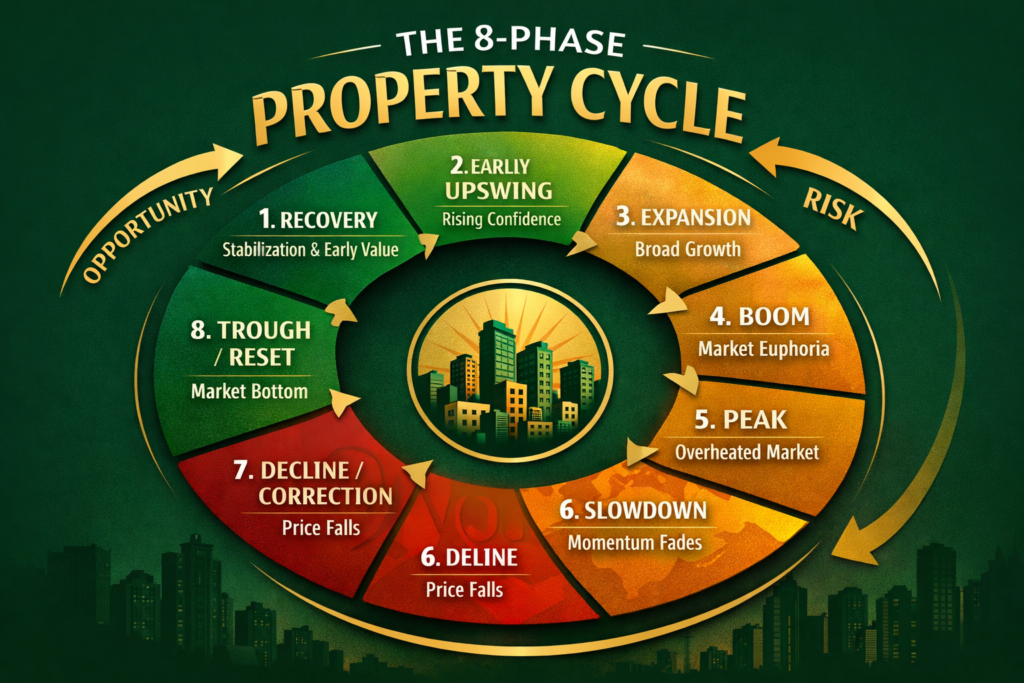
Asunción approved around 280 to 288 multi-storey building projects in 2024, according to municipal reporting. The municipality expected 2025 approvals to exceed that level. While we do not yet have final confirmation that this growth occurred, reports of record revenue from building-plan approvals during 2025 suggest that approval activity likely exceeded 2024’s figures. Revenue spikes for brick manufacturers would also reflect strong growth in construction projects being approved. This might lead you to think we’re in the Boom phase of high-rise development of the city.
Look more closely, because the housing shortage is likely to persist for 6-7 more years at least, driven by internal demographics, not international immigration. A large younger generation is only now reaching the stage of life where they begin renting independently and forming their own households, which is reported to drive a major share of internal housing demand into the next decade. When you look at the number of apartments being constructed in the next 2 years there is still a short fall of apartments needed to supply internal demographic demand alone.
Rising international immigration only puts additional pressure on that shortfall. Paraguay’s housing deficit remains substantial, particularly in urban areas, which means the long-term demand story is still building. If immigration accelerates materially from here, as recent residency trends suggest it could, then Asunción may still be in the later part of its growth phase rather than fully into the boom phase, with the sharpest demand squeeze still to come.
This makes the Asunción investment story more attractive, even though investors still need to be cautious about the risks associated with uneven construction oversight. When you’re investing in the development of a growing city, the best entry point is often toward the later part of the Expansion phase before the boom get’s underway, in our opinion. So the time in ripe right now in 2026 despite a 20-30% increase in prices on 2025.
Investing too early in an expansion phase can mean taking on more of the risks that come with a less mature market: A workforce with less high-rise experience, weaker systems, more trial and error, and a greater chance that design, engineering, or execution issues have not yet been fully ironed out.
By the time a city reaches the later growth phase, prices may be higher, but the market is attracting more experienced developers, construction firms, consultants, and suppliers. That usually means a more capable workforce, better execution, and fewer of the early-stage problems that can affect building quality. In other words, paying a little more later in the cycle can sometimes lead to better capital preservation and capital gain, because the building is more likely to remain sound, desirable, and saleable over time.
Why Investors Are Getting Mixed Results
The opportunity is real but it’s not uniform at any level of the property market in Asuncion.
- Choose the right neigbourhood but the wrong building and you could loose your capital or capital gain expectation;
- Choose the right building but the wrong neighborhood and your capital gain could be sluggish.
- One developer can build a stand out quality building, then have another development that ends up with multiple problems due to rushing to meet the deadline or a different less experience workforce.
- One construction company delivers on time or just over, while others deliver a year later than scheduled.
- Just because the structure is sound doesn’t mean he contractors hired to finish the apartments do a stellar job. And just because finishings are a little shoddy, doesn’t mean the structure or engineering isn’t sound.
- Buildings selling off-plan can sell 75% of the apartments within a month or two. But the final 25% could take 6 months to sell at higher prices.
- Not all listings for rent or sale are listed online. Not all listings online are actually available.
- Rental returns vary widely within neighbourhoods. You can find a 2 bedroom furnished in Las Lomas for $850 or $1,600.
- Rental yields can be all over the place from 5% up to 15% depending on area and whether it’s managed by the owner, a lazy property company or an active property management company.
- According to airbnb the averaged RENTED price for a 1 or 2 bedroom is current $47-$50 yet when you look on the site itself you see prices as high as $73. Scratch below the surface and you’ll find the occupancy is on the lower side.
- Airbnb occupancy and yields vary. Current public market trackers show city-level occupancy around 58% on AirDNA, around 67% to 69% on Airbtics, and around 44% to 48% on AirROI depending on the exact market definition and date range used. Well managed and marketed Airbnb’s in a good location can get up to 70-80% occupancy on $47-$50 nightly rates, while higher priced nightly rates sit empty.
- Yield spreadsheets you get from agents and developers may even be inconsistent on the page. For example the stated income shows 73% occupancy but it’s listed at 80% on the same spreadsheet. That makes their project yield percent wrong as well.
At ever level you’re going to find inconsistencies which is a common in the “Growth” phase of the property boom and bust cycle. Even sale prices for a 1 or 2 bedroom apartment vary widely. A Classe C apartment might be overpriced just because newer buildings in the area are attracting higher prices and somehow the owner thinks Osmosis makes their apartment magically increase in value therefore. However that apartment can sit empty as wise investors head to the more reasonable offerings.
Listings often reflect seller or landlord expectations, not achieved sales, rents or actual demand. In the mid-priced apartment segment especially, online listings can create a distorted picture because some units remain advertised for many months, sometimes at last years asking prices, which can mislead buyers, landlords, and investors about the true market value of both buying and renting as well as leasing velocity. On the ground the reality is prices are higher than online listings would lead you to believe.
AND THEN THERE IS THIS……..
The Locked Box Wealth Phenomenon
 Another dynamic distorting the Asunción property investment apartment market is what might be called the “Locked Box Wealth” phenomenon. A noticeable share of apartments appear to be held less as homes or income-producing investments and more as parked wealth. There is a really large pool of empty dwellings at a time when the city is facing a housing shortage.
Census data, reported 19,653 unoccupied private dwellings in Asunción in 2022, including 11,865 classified as uninhabited and 2,920 listed for sale or rent. Recently, The Paraguay Post cited an industry estimate of around 30% of units may be vacant. Not all of those apartments will be “locked boxes,” of course, but the figures do support the view that a meaningful share of the city’s stock is sitting idle rather than functioning as normal market supply.
Another reason why visible supply can be deceptive. Some apartments may be owned by buyers whose priority is capital preservation, optionality, or wealth parking rather than rental income or a realistic sale. Others are technically “on the market,” but only at such inflated sale prices or rental rates that the owner appears largely indifferent to whether a tenant or buyer is ever secured.
In practical terms, that means part of the inventory is not truly competing in the market at all. It creates the impression of more available apartments than there really are, and higher prices that the market will tolerate than it actually will. It contributes to artificially inflate both sale and rental prices.
In short, this is a market where thoughtful investors may build generational wealth, but careless investors can just as easily lock away capital in the wrong box.
Navigating The Maya
Navigating the maya successfully means looking at each building and each yield spreadsheet on it’s own merit. In a market like Asunción, generational wealth is not usually created by buying whatever is newest, tallest, cheapest, or most heavily promoted. It is created by buying selectively, timing your entry well, choosing buildings that will still be desirable in ten to twenty years, and focusing on real demand rather than brochure-driven hype.
Paying close attention to neighbourhood direction, tenant fit, construction company track records, building management, the numbers on the spreadsheet are important. Asking whether the sale price leaves room for both income and capital growth if the asset is likely to hold value, rent well, and remain saleable over time.
Overpay for a poorly built apartment in the wrong building, rely heavily on inflated rental assumptions, or mistake visible listings for true market demand, and you may find yourself holding an asset that is difficult to rent, difficult to sell, and expensive to maintain.
The investors most likely to create long-term wealth in Asuncion will be the ones who stay grounded, dig beyond what they’re shown or told, work with people who understand the market deeply, and treat risk management as seriously as you world trading crypto or volatile stocks. In a city like Asunción, the prize can be substantial, but so can the cost of getting it wrong.
What Have We Learned?
- You need to be responsible for doing your research, and maybe work with property locators who are keeping up-to-date with their research.
- You need to focus on developers and construction companies that have experience in regulated markets, and who care about brand and reputation protection.
- The industry of independent inspection services has not started here yet. You may have difficulty finding independent inspectors to verify if the apartment you are considering is structurally sound.
- There are standout developers and construction companies operating in the city producing quality buildings, so you can get good quality in Asuncion.
- Assess the risks and have a risk management plan in place.
- Make friends, build relationships, form partnerships, work with professionals who return your call.
- DO NOT BASE YOUR DECISION ON PRICE AND YOUR BUDGET.
You want to be thinking in terms of return on investment, not simply the cheapest price that fits your budget. Paying a little more for the right building, in the right location, at the right stage of the cycle, could end up making you significantly more money over time. Paying a lot less for the wrong asset can cost you far more in weak rental performance, poor resale value, higher maintenance, or worst case scenario – your capital is trapped in a building that does not hold up.
One thing is for certain – relationships and research will go along way helping you make the right decisions.
If you do not have the time, local relationships, or experience to assess a fast-developing high-rise city like Asunción properly, it may be wise to work with a property locator who is keeping up to the minute with research as the market evolves. In a city moving from the growth phase toward the boom phase, conditions can shift quickly. New developers enter, supply changes, better opportunities emerge, and risks can either subside or increase. That is exactly why serious investors benefit from having someone on the ground who is not just selling listings, but helping them interpret what is actually worth buying.
This blog post is a general overview of a much deeper report we are presenting both live in Asunción and online via Zoom. In that presentation, we go further into the numbers, including standout developers and construction companies operating in the city, how buildings can be “unofficially” tiered by likely quality and positioning, rental yield examples, Airbnb versus long-term rental comparisons, internal and international migration trends, when we believe demand may peak, and how a global downturn in 2028 to 2029 could affect the boom phase. If you would like the fuller picture before making a buying decision, register here to attend the presentation online or in person, there’s no fee.

Sources:
We compiled the data to form our research and opinions for this blog post, and subsequent report and presentation in the following way.
- Market Intelligence AI Agents
- Online Research Municipality and Government websites, Developer and Construction websites, News sites, as well as statistic, census and survey data.
- Speaking directly to developers, construction project managers, building owners, civil engineers, architects, compliance agents, realtors, local investors s well as international investors, building managers and administrators.
References:
Official / Government Sources
- Instituto Nacional de Estadística (INE), Paraguay. Resultados Finales del Censo Nacional de Población y Viviendas 2022.
- Instituto Nacional de Estadística (INE), Paraguay. Caracterización de las viviendas y los hogares – CNPV 2022. Useful for vacancy, occupied vs unoccupied housing, and housing stock context.
- Instituto Nacional de Estadística (INE), Paraguay. Déficit habitacional en Paraguay, 2022. Useful for the housing deficit and urban shortfall discussion.
- Dirección Nacional de Migraciones, Paraguay. Residencias en Paraguay: 2025 cierra con cifras históricas y 2026 arranca con fuerte crecimiento. Useful for 2025 residency applications and approvals.
- Municipalidad de Asunción. Auspiciosos proyectos edilicios posicionan a Asunción como una de las urbes de mayor crecimiento en Sudamérica. Useful for the 2024 multi-storey building approvals figure.
Market / Industry Data
6. AirDNA. Asuncion Short-Term Rental Market Overview.
7. AirROI. Asunción Airbnb Market Analysis 2026.
8. Airbtics. Paraguay Short-Term Rental Market Report 2025 and Asuncion Airbnb Data 2026.
9. Corporate Stays. Furnished Apartments in Asunción / expansion announcement.
Media / Commentary Sources
10. ABC Color. Asunción y Central: la cantidad de viviendas deshabitadas y abandonadas según el INE.
11. ABC Color. Censo 2022: ¿Cuántas viviendas hay en Paraguay?
12. The Paraguay Post. Paraguay’s Luxury Property Boom Defies Gravity—and Logic.